Niacinamide vs Vitamin C: Which One Is Better for Your Skin?
The Answer Is Annoyingly Simple: It Depends on What You’re Asking It to Do.
You open Instagram.
Someone tells you:
“Vitamin C is essential.”
Scroll twice.
Someone else says:
“Niacinamide changed my life.”
Scroll again.
Now somebody has layered Vitamin C, Niacinamide, Alpha Arbutin, Tranexamic Acid, Retinol before breakfast.
And somehow your perfectly normal face starts feeling underdressed.
So today, instead of asking:
Which Ingredient Is Better?
Let’s ask the question that actually matters:
Which One Is Better for Your Skin, Your Concern and Your Routine?
Because vitamin C and niacinamide are not competing football teams.
You do not have to choose a side.
And you certainly do not need to use both simply because TikTok has declared them “essentials.”
The 20-Second Answer
If you don’t want to read the whole article—and you absolutely should, because I am emotionally invested now—here’s the quick version.
Choose Vitamin C if your priorities are:
- Dullness
- Antioxidant support
- Sun-related visible damage
- Uneven-looking tone
- Brightness
Choose Niacinamide if your priorities are:
- Oiliness
- Barrier support
- Uneven pigmentation
- Redness-prone or easily irritated skin
- General skin maintenance
Choose both if:
- they suit your skin,
- your routine has a reason for both,
- and you aren’t introducing six other actives at the same time.
That’s the short answer.
Now let’s make it useful.
First: What Exactly Is Niacinamide?
Niacinamide—also called nicotinamide—is a form of vitamin B3.
And this is one ingredient where the skincare hype is not entirely unjustified.
It has several biologically relevant functions in skin and has been investigated for barrier support, pigmentation, oil production, redness, fine lines, and overall skin appearance.
Recent Indian evidence reviews continue to include niacinamide among useful adjunctive ingredients for hyperpigmentation because of its barrier-supporting, anti-inflammatory and pigmentation-related actions.
But notice the wording:
useful.
Not:
miraculous.
That distinction will save us a lot of money.
What Does Niacinamide Actually Do?
1. It Can Support the Skin Barrier
Your skin barrier is essentially your outer defence system.
A healthy barrier helps:
- retain water,
- reduce irritation,
- and keep environmental stressors out.
Niacinamide has been studied for its ability to support epidermal barrier function and lipid synthesis.
This becomes particularly interesting for Indian consumers who are simultaneously using acne products, exfoliating acids, retinoids, pollution-heavy urban routines, and possibly washing their face as though it owes them money.
2. It Can Help With Uneven Pigmentation
Niacinamide does not work by “bleaching” skin.
And thank goodness.
One of its better-understood pigmentation mechanisms relates to reducing the transfer of melanosomes—pigment-containing structures—from melanocytes to surrounding keratinocytes.
In plain English:
It can help make uneven pigmentation look more even.
That’s particularly relevant in Indian skin because pigmentation disorders and post-inflammatory marks are very common. Indian expert consensus published in 2026 lists niacinamide among the agents considered suitable for post-inflammatory hyperpigmentation.
3. It Can Be Useful for Oily Skin
Niacinamide is frequently incorporated into formulas aimed at oiliness, congestion, acne-prone skin.
Does this mean:
Niacinamide cures acne?
No.
Please don’t make ingredients do jobs they weren’t hired for.
If you have significant acne, evidence-based acne treatments such as retinoids, benzoyl peroxide or salicylic acid may be more directly relevant depending on the type of acne.
But niacinamide can fit nicely around such routines.
4. It’s Generally Easy to Fit Into a Routine
This may be niacinamide’s greatest strength.
It’s not necessarily the most glamorous active.
But it is versatile.
Which makes it one of skincare’s best:
“I don’t know exactly what to do, but I want one sensible serum” ingredients.
And I mean that as a compliment.
Now, What Is Vitamin C?
Vitamin C is an antioxidant.
But that word has been repeated so often in skincare marketing that it has almost stopped meaning anything.
So let’s unpack it.
Our skin is exposed to oxidative stress from things including UV radiation, pollution, and normal metabolic processes.
Antioxidants help neutralize reactive molecules involved in oxidative damage.
Vitamin C also plays a role in collagen biology and pigmentation-related pathways.
That is why topical vitamin C became one of dermatology’s most discussed cosmetic ingredients.
What Can Vitamin C Actually Help With?
1. Dullness and Brightness
This is probably the reason most consumers buy it.
Vitamin C can support brighter, more even-looking skin.
But let’s clarify:
Brighter ≠ whiter.
India has spent decades confusing those two ideas.
Your natural skin tone is not something vitamin C needs to “fix.”
The relevant targets are:
- uneven tone,
- sun-induced pigmentation,
- post-inflammatory marks,
- and dullness.
Indian pigmentation literature specifically recognizes vitamin C as one of the topical agents used in pigmentation management.
2. Antioxidant Support
This is where vitamin C gets particularly interesting in the morning.
A vitamin C serum is often used underneath sunscreen because:
Sunscreen reduces UV reaching the skin.
while
Antioxidants help deal with some oxidative stress that still occurs.
They perform different jobs.
Therefore:
Vitamin C is not a substitute for sunscreen.
No antioxidant serum gives you permission to skip SPF.
3. Photoageing Support
Topical vitamin C has been studied for visible signs associated with sun exposure, including roughness, pigmentation, and fine lines.
A recent network meta-analysis of topical interventions for photoageing evaluated vitamin C among the active ingredients used for outcomes such as hyperpigmentation, roughness and wrinkles, reinforcing that it belongs in the evidence-informed photoageing conversation rather than purely marketing folklore.
So Which One Is “Stronger”?
This question sounds reasonable.
It isn’t.
Stronger at what?
Imagine comparing an umbrella with a water bottle.
Which is better?
For rain?
Umbrella.
For dehydration?
Water bottle.
That’s basically the vitamin C versus niacinamide argument.
Different strengths.
Different functions.
Some overlap.
Here’s the Real Comparison
| Concern | Vitamin C | Niacinamide |
|---|---|---|
| Dullness | Excellent fit | Helpful |
| Uneven tone | Very useful | Very useful |
| Post-acne marks | Useful | Useful |
| Antioxidant support | Major strength | Supporting role |
| Oily skin | Limited direct role | Better fit |
| Barrier support | Not primary role | Major strength |
| Redness-prone skin | Depends on formulation | Often easier fit |
| Photoageing | Strong rationale | Useful supporting ingredient |
| Sensitive beginner | Depends heavily on formula | Often easier starting point |
| Morning routine | Excellent | Excellent |
| Night routine | Fine | Excellent |
And now for the irritating but important sentence:
Formulation can matter more than the ingredient name.
Vitamin C Is Not One Ingredient
This is where skincare gets interesting.
When consumers say:
“I use vitamin C.”
I immediately want to ask:
Which vitamin C?
Because topical vitamin C can appear as:
- L-ascorbic acid,
- 3-O-ethyl ascorbic acid,
- magnesium ascorbyl phosphate,
- ascorbyl glucoside,
- sodium ascorbyl phosphate,
- and other derivatives.
These forms can differ in:
- stability,
- pH requirements,
- skin feel,
- penetration,
- and available clinical evidence.
So comparing:
“10% Vitamin C”
to
“15% Vitamin C”
without knowing the form can be meaningless.
And 20% Is Not Automatically Better Than 10%
This deserves its own section because skincare percentages have become a competitive sport.
Consumers now think:
- 5% = beginner.
- 10% = serious.
- 15% = advanced.
- 20% = enlightenment.
That’s not formulation science.
That’s a leaderboard.
A well-designed lower-percentage formulation may outperform a poorly stabilized higher-percentage one.
What matters is:
- form
- stability
- delivery
- supporting antioxidants
- packaging
- tolerance
- consistency
Not:
Who has the biggest number on the box?
The Same Problem Exists With Niacinamide
Once 5% niacinamide became popular, brands launched 10%.
Then 12%.
Then 15%.
Then 20%.
Eventually we may just rub a vitamin B3 tablet directly across our forehead and call it innovation.
Higher concentrations can increase irritation in some people without necessarily producing proportionately better cosmetic outcomes.
So don’t buy niacinamide by percentage alone either.
Which One Is Better for Indian Skin?
Now we get to the useful part.
There is no single biological entity called:
“Indian skin.”
India contains an enormous range of skin tones, oil levels, barrier characteristics, climates, genetics, and lifestyles.
However, pigmentation is particularly relevant.
A review focused on India reported facial skin-tone heterogeneity in more than 80% of participants across four Indian cities, with pigmentation concerns including dark spots, melasma and post-inflammatory marks playing major roles.
More recent Indian expert consensus similarly identifies melasma, post-inflammatory hyperpigmentation, acquired dermal macular hyperpigmentation, and periorbital hyperpigmentation as priority pigmentary concerns.
So both vitamin C and niacinamide can make sense.
But for different reasons.
If You Have Oily, Acne-Prone Indian Skin…
I would generally look more closely at:
Niacinamide.
Why?
Because you’re often trying to manage several overlapping issues:
- oiliness,
- barrier function,
- inflammation,
- and marks after acne.
That doesn’t mean niacinamide treats acne on its own.
It means it can be a very practical supporting ingredient.
Your actual acne treatment may still need:
- salicylic acid,
- benzoyl peroxide,
- adapalene,
- or dermatologist-prescribed therapy.
If Your Biggest Problem Is Dullness…
I would probably lean:
Vitamin C.
Especially if your skin tolerates it well and you want antioxidant support, more radiance, and help with uneven-looking tone.
Morning is a particularly logical place for it.
If Your Main Problem Is Post-Acne Marks…
Now things get interesting.
Because:
Both can make sense.
Indian expert consensus includes both vitamin C and niacinamide among options used in PIH management.
But here’s the mistake:
People treat the mark while ignoring the acne still creating marks.
If you get five new inflammatory pimples every week, your pigmentation routine is fighting a moving target.
First control:
the inflammation.
Then improve:
the aftermath.
If You Have Sensitive Skin…
Niacinamide often has the easier reputation.
But don’t turn that into:
“Niacinamide can never irritate.”
Anything can irritate someone.
Especially when brands start using very high percentages or combining multiple active ingredients.
And vitamin C can also be perfectly tolerable when the formula is appropriately designed.
Again:
Formula > internet reputation.
If You Have Melasma…
Please stop treating melasma as:
“extra stubborn tanning.”
It is a chronic pigmentary disorder.
UV exposure, visible light, hormones and other biological factors can all contribute.
Indian experts emphasize individualized multimodal management and prevention of relapse—not simply finding one magic brightening serum.
Vitamin C or niacinamide can have supporting roles.
Neither should be sold as:
“The melasma cure.”
Can You Use Vitamin C and Niacinamide Together?
Yes.
I knew we would eventually reach this question.
And please ignore the ancient internet myth that:
“Vitamin C and niacinamide cancel each other out.”
This concern largely comes from extrapolation of older chemical conditions that do not meaningfully represent normal modern cosmetic formulation and use.
Modern routines and products regularly combine them.
There is no general skincare rule saying:
Vitamin C + Niacinamide = forbidden.
But Should You Use Them Together?
Different question.
And my answer is:
Maybe.
Because “compatible” doesn’t mean:
necessary.
Imagine your skin is doing very well with vitamin C, moisturiser, sunscreen.
Do you need niacinamide?
Not necessarily.
Likewise, if your niacinamide routine controls oiliness and supports your barrier beautifully:
Do you need vitamin C?
No skincare police will visit your home if you don’t own it.
If You Want Both, Here Are Three Easy Ways
Option 1 — Both in the Morning
- Cleanse
- Vitamin C
- Niacinamide
- Moisturiser if needed
- Sunscreen
This can work if both products layer comfortably and your skin tolerates them.
Option 2 — Split Them
AM
- Vitamin C
- Moisturiser
- Sunscreen
PM
- Niacinamide
- Moisturiser
This is probably the easiest approach for someone who doesn’t want seven layers under Indian summer humidity.
Option 3 — Use a Formula That Already Contains Complementary Actives
This brings us to an important philosophy:
You don’t need one bottle per ingredient.
A properly developed formula can contain several complementary components.
The skincare shelf does not earn commission based on bottle count.
What About India’s Heat and Humidity?
This is surprisingly important.
A routine that looks elegant in London in January may feel horrific in Mumbai in May.
Humidity, sweating, oiliness and the experience of sunscreen matter.
A technically brilliant routine that feels sticky, heavy, greasy, or pills underneath sunscreen is a routine you eventually stop using.
So Indian consumers should evaluate:
texture.
Not just ingredient lists.
Because:
The product you consistently use will usually be more useful than the “perfect” product you hate applying.
What About Pollution?
Indian consumers hear the phrase:
“anti-pollution skincare”
constantly.
Sometimes it’s meaningful.
Sometimes it’s marketing wearing a lab coat.
Urban pollution can contribute to oxidative stress, which is another reason antioxidants are interesting.
But the fundamentals remain boringly effective:
- gentle cleansing,
- antioxidant support if desired,
- moisturisation,
- and sunscreen.
You do not necessarily need a separate:
- “pollution serum.”
- “detox serum.”
- “urban defence essence.”
- “city shield booster.”
Please save some shelf space.
The Biggest Mistake People Make With Both Ingredients
They use them while damaging the skin with everything else.
For example:
Morning
- Vitamin C
- Niacinamide
- Glycolic toner
- Scrub
- Sunscreen
Evening
- Retinol
- AHA
- BHA
- Niacinamide
- Peel
and then:
“Why is my skin sensitive?”
Your skin would like a lawyer.
Your Skin Barrier Is Not an Obstacle to Results
This point matters particularly for pigmentation-prone Indian skin.
Inflammation can worsen pigmentation.
The 2026 Indian expert consensus explicitly warns that irritation, inflammation, epidermal injury and thermal injury can worsen or trigger PIH in skin of colour, recommending gradual escalation, barrier optimization and careful photoprotection.
So if your pigmentation routine constantly burns, peels, stings, and inflames your face, you may be creating exactly the problem you’re trying to treat.
Aggression is not efficacy.
Now Let’s Talk Eternal Bright
This is where Eternal Bright can make a much stronger argument than:
“Ours is better.”
Instead:
Here’s how you decide which one fits you.
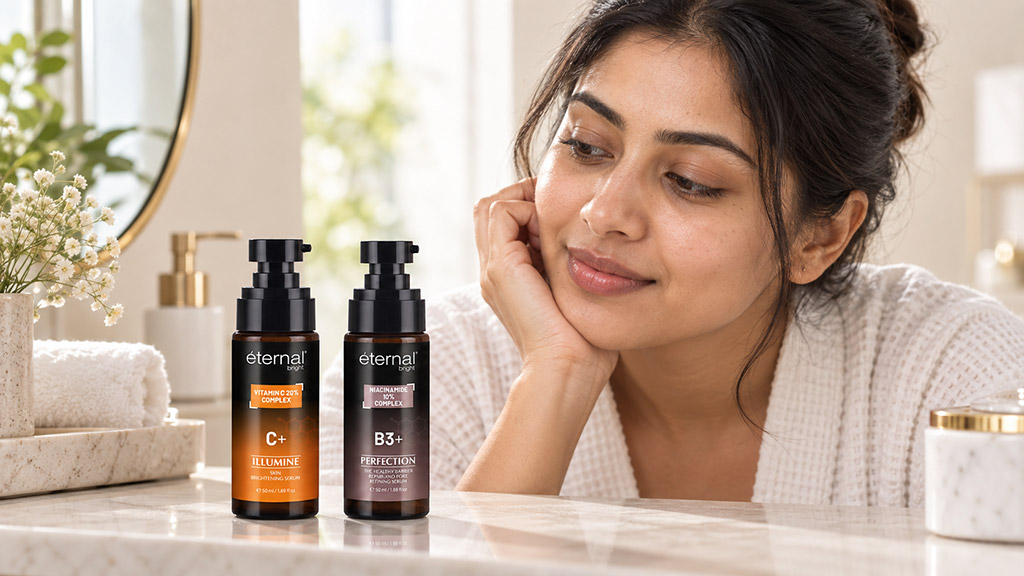
Eternal Bright B3+ Niacinamide Serum
The formulation is designed around:
- 10% Niacinamide for multi-functional skin support,
- 1% Zinc PCA particularly relevant to oily and blemish-prone skin positioning,
- 1% Hyaluronic Acid for hydration,
- and 2% D-Panthenol for soothing and barrier-supportive care.
So I would position it for someone saying:
“My skin gets oily, my barrier sometimes feels unsettled, I get uneven-looking marks and I want one versatile daily serum.”
Not:
“Everyone needs 10% niacinamide.”
Those are very different messages.
Eternal Bright C+ Illumine Vitamin C Serum
Instead of treating vitamin C as one number, Eternal Bright uses a multi-form vitamin C approach.
The formulation combines vitamin C forms including:
- 3-O-Ethyl Ascorbic Acid
- Superox-C AF
- Magnesium Ascorbyl Phosphate
alongside:
- 0.8% Ferulic Acid
- 0.8% Vitamin E
- 1% Hyaluronic Acid
- and 1% Olive Leaf
The logic is:
Antioxidant support + brightening + hydration.
That makes more sense for someone saying:
“My skin looks dull, uneven and tired and I want antioxidant and brightening support.”
Again:
not everybody.
The relevant person.
Which Eternal Bright Serum Should You Choose?
Choose B3+ Niacinamide when you primarily think:
- Oiliness
- Uneven tone
- Barrier
- Post-blemish appearance
- General maintenance
Choose C+ Illumine when you primarily think:
- Dullness
- Brightness
- Antioxidants
- Environmental exposure
- Sun-related uneven tone
Consider both when:
- you genuinely have overlapping concerns,
- your skin tolerates both,
- and the rest of your routine is reasonably simple.
Not because:
The website had an “Add Both” button.
Here’s the Question Nobody Asks: What if You Need Neither?
This is my favourite section.
Suppose you’re 21.
Your skin is comfortable, mostly clear, not particularly oily, not significantly pigmented, and not dull.
You use cleanser, moisturiser, sunscreen.
Do you need vitamin C?
No.
Niacinamide?
Also no.
A serum?
No.
Your skin is allowed to be fine.
You don’t have to invent a problem to participate in skincare.
What if You Can Only Afford One?
Good.
That forces us to make an actual decision instead of pretending skincare needs unlimited budgets.
Ask:
“What bothers me most?”
Oily / blemish-prone / barrier-conscious?
Start with:
Niacinamide.
Dull / uneven / antioxidant-focused?
Start with:
Vitamin C.
Then use it consistently.
You may discover you never needed the second one.
What if You’re a Beginner?
I would generally favour simplicity.
Pick:
one treatment serum.
Use it for a reasonable period.
Observe:
- tolerance,
- texture,
- oiliness,
- marks,
- brightness.
Then decide whether something is missing.
The worst beginner routine is often the one built by someone who learned 12 ingredient names before learning their own skin.
And Please Don’t Forget Sunscreen
Especially if pigmentation is your concern.
India’s Pigmentary Disorders Society emphasizes photoprotection as part of preventing and managing hyperpigmentation, and notes that pigmentation in darker phototypes can be more persistent.
There is something deeply inefficient about spending:
- ₹1,500 on vitamin C,
- ₹1,200 on niacinamide,
- ₹1,900 on pigmentation serum,
- and then using half a pea of sunscreen at 8 AM.
The routine hierarchy is:
Protect first.
Then optimize.
The Final Verdict
So:
Niacinamide vs Vitamin C.
Who wins?
Neither.
Because skincare isn’t a knockout competition.
Niacinamide
is the versatile problem-solver.
It is particularly useful when your concerns include oiliness, barrier support, uneven tone, and post-blemish marks.
Vitamin C
is the antioxidant-brightening specialist.
It makes particular sense when you’re targeting dullness, environmental oxidative stress, visible sun damage, and uneven tone.
Both
can work together.
Neither
is compulsory.
And that last sentence may be the most important one.
Don’t Ask:
“Which ingredient is better?”
Ask:
“Which ingredient has a job in my routine?”
That’s how you stop shopping by trend.
And start shopping by purpose.
Eternal Bright
C+ Illumine
When your skin needs antioxidant-powered brightness.
B3+ Niacinamide
When your skin needs balance, barrier support and more even-looking tone.
And the larger philosophy:
The right ingredient isn’t the most famous one. It’s the one your skin has a reason to use.
Understand more. Choose better.
SEO FAQ Section
Is niacinamide better than vitamin C?
Neither is universally better. Niacinamide is particularly versatile for barrier support, oiliness and uneven tone, while vitamin C has a stronger role as an antioxidant and brightening ingredient.
Can vitamin C and niacinamide be used together?
Yes. Modern skincare does not require separating them because of the old “they cancel each other” myth. Whether you need both depends on your concerns and tolerance.
Which is better for pigmentation in Indian skin?
Both may have supporting roles. The 2026 Indian expert consensus lists vitamin C and niacinamide among topical options used for post-inflammatory hyperpigmentation, but persistent pigmentation may require diagnosis and a broader treatment plan.
Which is better for oily skin?
Niacinamide generally makes more sense because of its broader relevance to oiliness, barrier function and blemish-prone routines.
Which is better for glowing skin?
Vitamin C is usually the more direct choice when the primary goal is brightness and antioxidant support.
Which should beginners use first?
Choose according to your concern. A beginner with oily, reactive or blemish-prone skin may find niacinamide easier to incorporate; someone primarily concerned with dullness may prefer vitamin C.
Can I use them every day?
Many formulations are designed for daily use, but frequency depends on the complete formula and your skin’s tolerance. Introduce new actives gradually rather than starting several products simultaneously.
Should I use vitamin C in the morning or evening?
It can be used at either time depending on formulation, but morning use is popular because its antioxidant role complements—not replaces—daytime sunscreen.
Does niacinamide make skin fair?
No skincare ingredient should be framed as changing your genetically determined complexion. Niacinamide may help improve uneven pigmentation and make skin appear more even.
Does vitamin C make skin fair?
Vitamin C may improve dullness and uneven pigmentation, giving skin a brighter appearance. “Brighter” should not be confused with changing someone’s natural skin colour.
And if I wanted one headline capable of becoming the social campaign behind this blog, I would use:
Vitamin C or Niacinamide? Your Skin Doesn’t Care Which One Is Trending.
It cares which one it needs.
That feels much more Eternal Bright than another predictable “Vitamin C vs Niacinamide — Who Wins?” comparison.