What Is NAD+ and Why Is It Suddenly in Every Skincare Routine? A Clear Guide for Indian Skin
You open Instagram or Nykaa and NAD+ is everywhere—serums, “longevity” drops, clinic recommendations. The question most people actually have is simpler: what does this do for my skin, and does it make sense in India’s climate?
This is the practical version.
The One-Sentence Answer
NAD+ is the molecule your skin cells use for energy and repair. Levels drop with age and stress. Putting supportive forms of it in a serum is an attempt to help cells do their jobs better—not to stop time.
What NAD+ Actually Is
NAD+ (nicotinamide adenine dinucleotide) sits inside almost every cell. It is required to turn food into usable energy (ATP) and to power DNA repair enzymes and sirtuins—the proteins involved in cellular maintenance.
When NAD+ is plentiful, skin cells repair UV damage more efficiently, maintain structure better, and handle oxidative stress with less visible fallout. When levels fall, those processes slow. Research shows meaningful declines by the forties and fifties; pollution, high UV and poor sleep accelerate the drop further.
Why This Matters More for Indian Skin
Indian skin (mostly Fitzpatrick III–V) lives under continuous pressure:
- High UV index most of the year
- Urban pollution and particulate matter
- Heat and humidity that stress the barrier
- Stronger melanocyte responses, so any inflammation easily becomes long-lasting pigmentation
The usual result is not just fine lines. It is dullness, slower recovery, loss of bounce, and stubborn uneven tone. Supporting the cell’s energy and repair systems is one way to address that pattern without aggressive irritation that can make pigment worse.
This sits closer to a proaging mindset (help skin age with better quality) than classic anti-aging (try to erase every change).
What You Can Reasonably Expect from NAD+ in Skincare
In well-formulated products, NAD+ or its precursors (especially niacinamide) aim to support:
- DNA repair after sun and pollution exposure
- Mitochondrial energy so cells can renew and produce matrix proteins
- Barrier strength and calmer low-grade inflammation
- Collagen and elastin maintenance
- More even tone by reducing the oxidative stress that can push melanocytes
Niacinamide already has solid clinical data on texture, barrier and pigmentation for multiple skin types, including Indian skin.
Direct NAD+ is larger and harder to deliver, so better formulas combine it with precursors, delivery systems and complementary actives.
NAD+ Serum vs NAD+ Multi Peptide Serum
A plain NAD+ serum focuses on energy and repair. A NAD+ multi peptide serum pairs that with peptide signals that tell fibroblasts to build more collagen and elastin.
Common Peptides Used in NAD+ Multi Peptide Serums
- Matrixyl 3000: Signal peptide complex for skin structure support
- Copper tripeptide-1: Supports skin remodeling
- Acetyl hexapeptide-3: Targets the appearance of expression lines
- EGF-like peptides: Support skin renewal
Energy without clear structural signals is incomplete. Signals without energy are less effective. The combination targets both the cellular decline and the firmness loss common as skin ages in India’s environment.
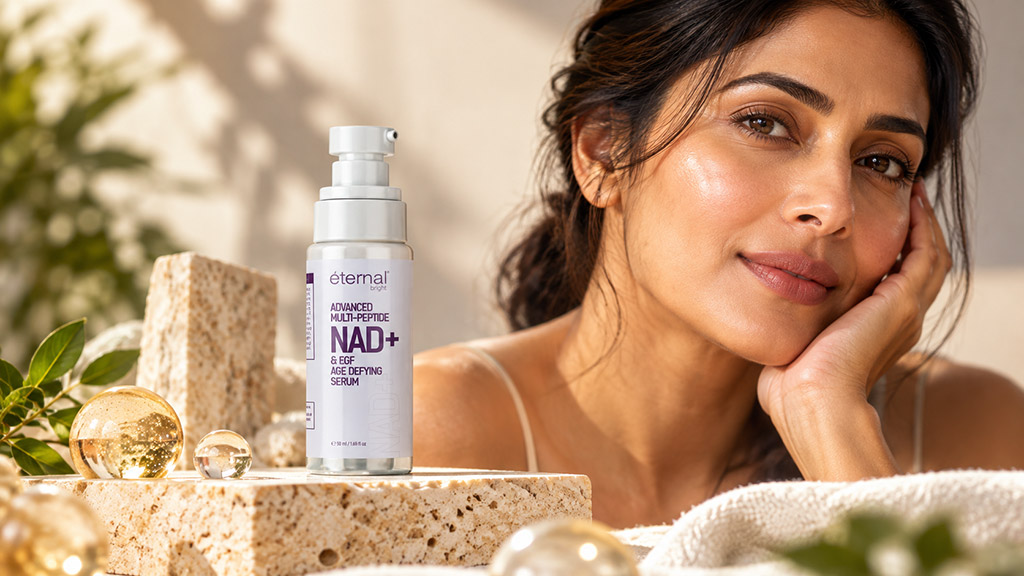
Where Eternal Bright NAD+ Multi Peptide Serum Fits
Eternal Bright NAD+ Multi Peptide Serum is built on this pairing for Indian conditions.
Key Ingredients in Eternal Bright NAD+ Multi Peptide Serum
- NAD+
- Matrixyl 3000
- Acetyl hexapeptide-3
- Copper tripeptide-1
- EGF
- Niacinamide
- Alpha arbutin
- Ceramides
- Supporting hydrators
It is intended for evening use when repair is naturally higher and is positioned as cellular support rather than surface whitening.
It is available on the brand site and major Indian platforms (Clinikally, Amazon, Nykaa).
As with any active, results are gradual—cellular support starts quickly; visible changes in texture, firmness and radiance are typically noticed over 4–6 weeks when used consistently with daily SPF 50+.
How to Use It Without Overcomplicating Your Routine
Morning Skincare Routine
- Gently cleanse your face
- Apply an antioxidant
- Use broad-spectrum SPF 50 sunscreen
- Reapply sunscreen as needed since India’s UV exposure is not seasonal
Evening Skincare Routine
- Cleanse your skin thoroughly
- Apply a NAD+ serum or NAD+ multi peptide serum
- Follow with a moisturizer that supports the skin barrier
Using NAD+ Serum with Retinoids
Many people alternate nights with a well-tolerated retinoid once their barrier is stable. Introduce one new active at a time. Indian skin can react to sudden intensity with pigment or sensitivity.
Key Takeaways: NAD+ Skincare for Indian Skin
- NAD+ is cellular energy and repair fuel, not a miracle eraser.
- Levels decline with age and are stressed further by India’s UV, pollution and heat.
- Supporting it helps skin stay more resilient, even and firm longer—closer to proaging than aggressive anti-aging.
- Best results come from consistent use and daily sunscreen, not from the serum alone.
- A multi-peptide version adds structural signals on top of the energy support.
Want the Practical Next Step?
If you are building a routine that prioritizes strength and evenness over chasing a younger face, a NAD+ multi peptide serum is one of the more logical additions currently available in India.
Pair it with SPF, a stable barrier and realistic expectations, and it becomes a useful long-term tool rather than another trend.
I update these pieces when new data or formulation details become relevant. If you want the next breakdown (how to layer this with retinoids, vitamin C or professional treatments without irritation), let me know what you’re currently using.